
GeoScratch is a block-based environment for learning 3D geometry and linear algebra, and the subject of my honours research. The idea behind it is simple: humans already have an enormous head start when it comes to three dimensional space. We've been navigating it, judging depth, and tracking objects moving through it since before we could talk. That's intuition your visual system builds for free, and it's a much better foundation to teach from than intuitions about, say, prime numbers, which are hard-won and mostly reserved for professional mathematicians. My research asks what happens if we design 3D geometry teaching tools around that existing visual intuition, instead of asking students to painfully rebuild it from formulas and static diagrams alone.
Textbook diagrams, lecture slides, and notes on a whiteboard are all flat. Every time you look at a page and try to work out which line is in front, how far apart two points really are, or what a rotation actually looks like, you're doing translation work the page isn't helping you with. Your brain is used to real depth cues: shadows, lighting, occlusion. Take those away, and even someone who understands the maths perfectly can misjudge the picture. That's not a knowledge gap, it's a perception gap, and it's the gap GeoScratch is trying to close.
Instead of static diagrams, GeoScratch renders shapes using existing research on visual perception: shadows that ground objects in space, occlusion management that reveals what's in front of what. Scenes are built by snapping together blocks for vectors, planes, lines, and primitive shapes, rather than writing out coordinates and formulas by hand.
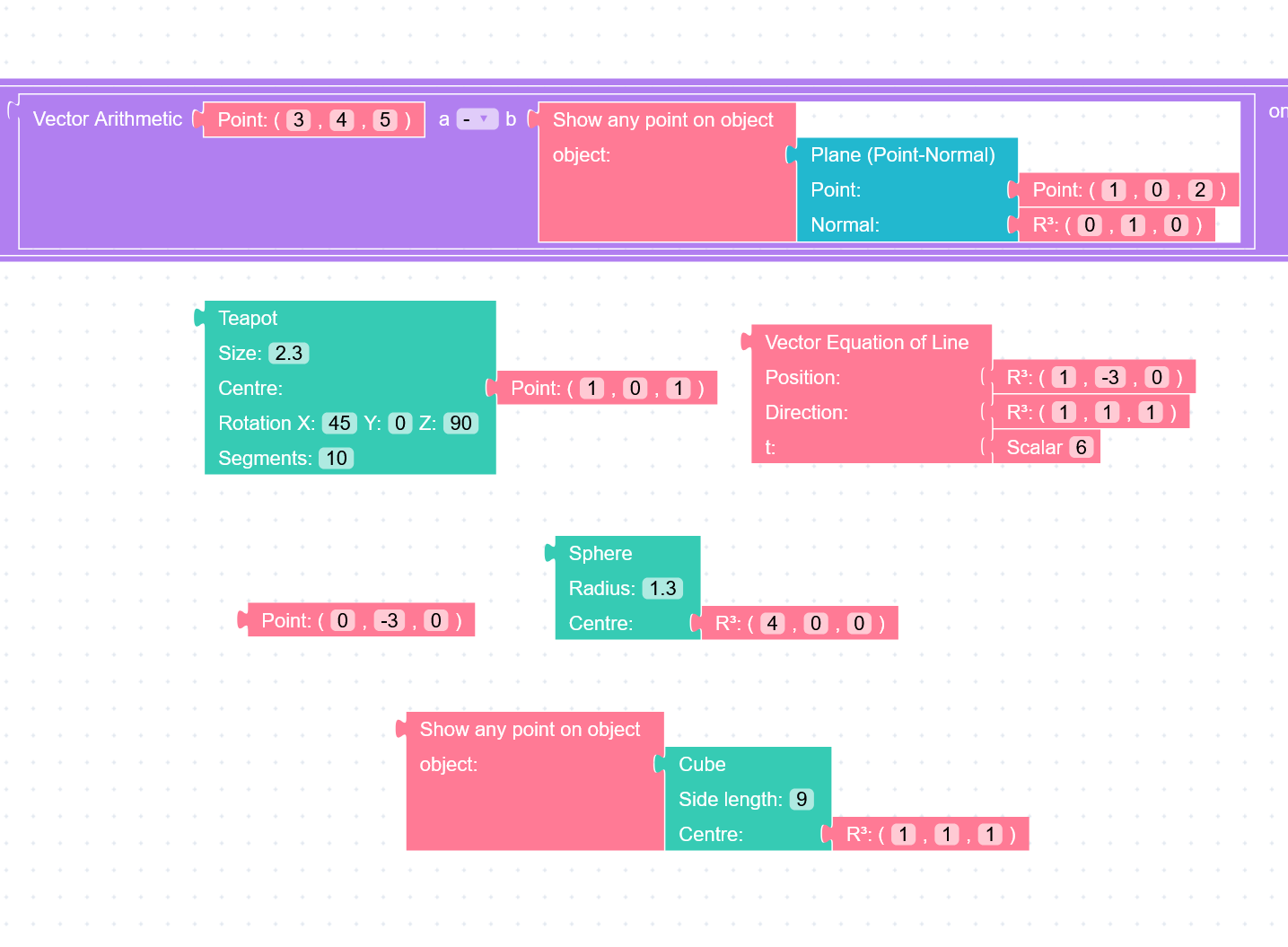
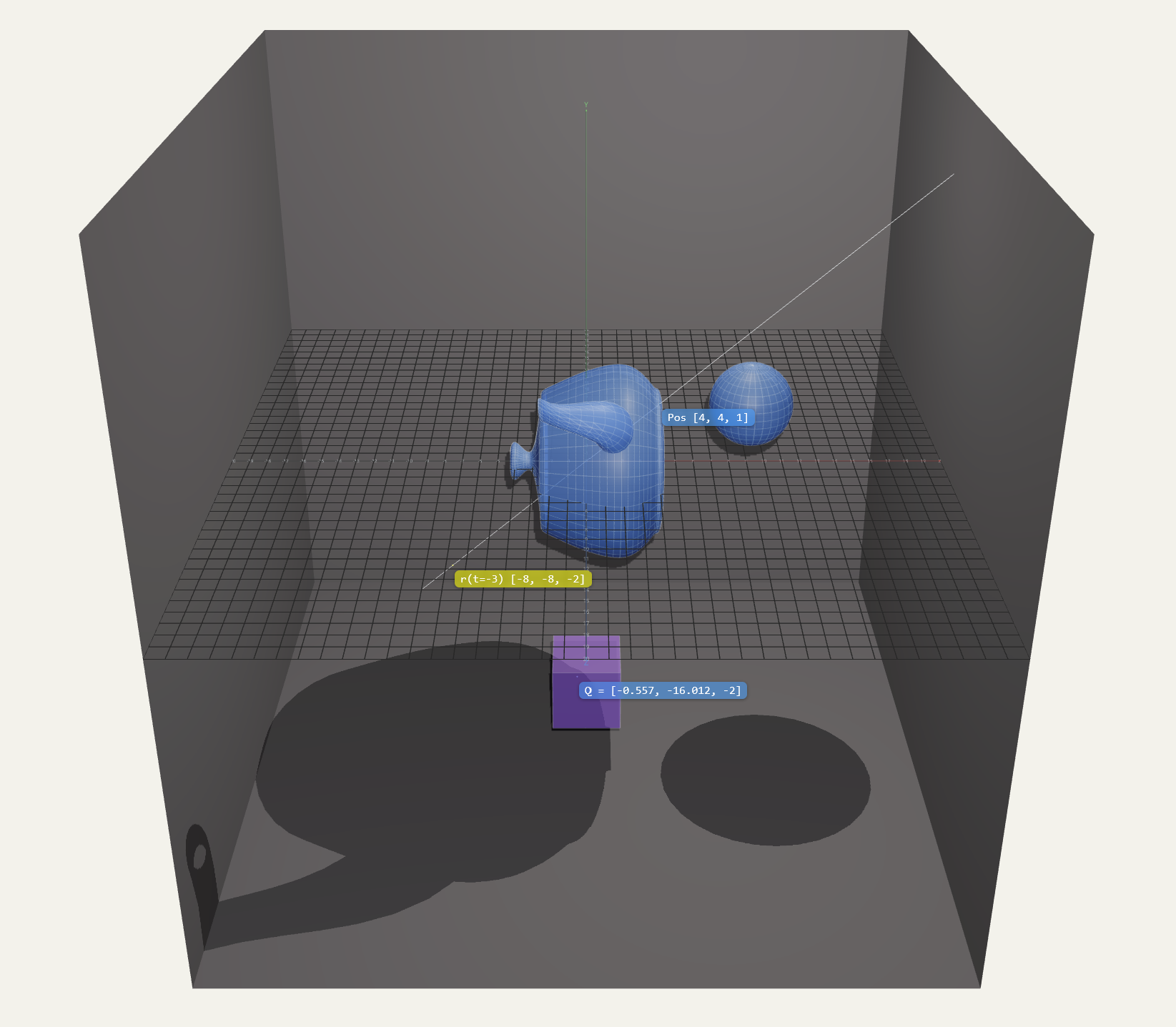
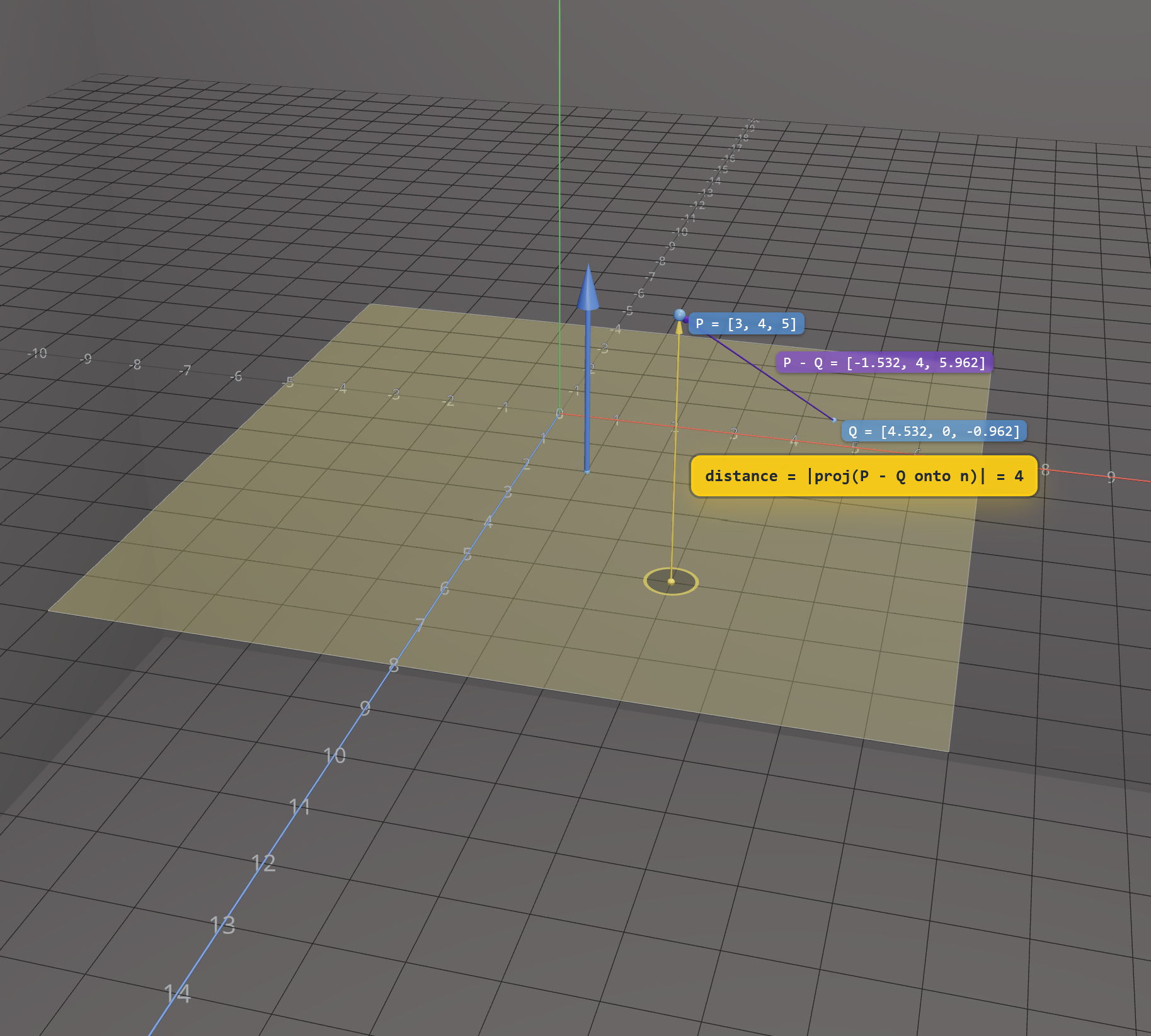
There's a second piece to it beyond just rendering. Most tools show you the answer, a finished vector or a completed projection, as a static result, without ever showing you how it got there. GeoScratch animates the solution process itself, letting students watch a rotation unfold or a projection form step by step rather than just staring at where it ended up. Subtle motion and highlighting also guide a student's attention to exactly the part of the scene that matters most, the way an annotated distance calculation below draws your eye straight to the value it's explaining.
None of this is guaranteed to actually help, which is where the research comes in. I'm testing whether these techniques measurably improve how quickly and accurately people judge depth and orientation, and whether watching a process animate, rather than just seeing its result, helps them understand that process more clearly. That part is still ongoing, so consider this post a progress report rather than a conclusion. For a lot of students, staring at a formula with no way in is the whole problem, and if tools can lead with what the eye already knows how to do before asking students to translate that into symbols, they can close some of the gap between the intuition a student already has and the page of formulas that's supposed to describe it.
If you're studying (or have studied) computer science, engineering, or a related field, can complete a questionnaire in English, and have normal vision and hearing, I'm looking for participants for a 1 hour study on using GeoScratch to learn 3D geometry. All skill levels welcome, rusty geometry included.
Get in touch at finleyjohnneilson@gmail.com if that sounds like you.